About the Journal

Misan Journal of Political and International Studies is a semi-annual peer-reviewed general political scientific journal concerned with publishing international research and studies in various fields of knowledge for the political sciences specialty. It is issued by the College of Political Sciences at the University of Maysan, affiliated with the Ministry of Higher Education and Scientific Research in the Republic of Iraq. The magazine provides its services In its electronic and paper versions, for researchers inside and outside Iraq, it publishes the research of graduate students and scientific conferences recognized by the Ministry. The magazine includes in its editorial board scientific figures with a fragrant history, from inside and outside Iraq, with the aim of enriching the scientific research submitted for publication, with scientific sobriety from In terms of methodology and content, which contributes to disseminating knowledge in this specialty, and achieving the required quality of scientific research, in a way that contributes to implementing the Ministry’s vision of developing and developing scientific research, enhancing the capabilities of researchers in acquiring intellectual skills in scientific research, and building bridges of scientific communication with faculties of political science. Debate, inside and outside Iraq, and the magazine also seeks to enter global understandings. The magazine is funded by the Ministry of Higher Education and Scientific Research through the Universities Fund, as well as fees for publishing research on its pages.

Current Issue
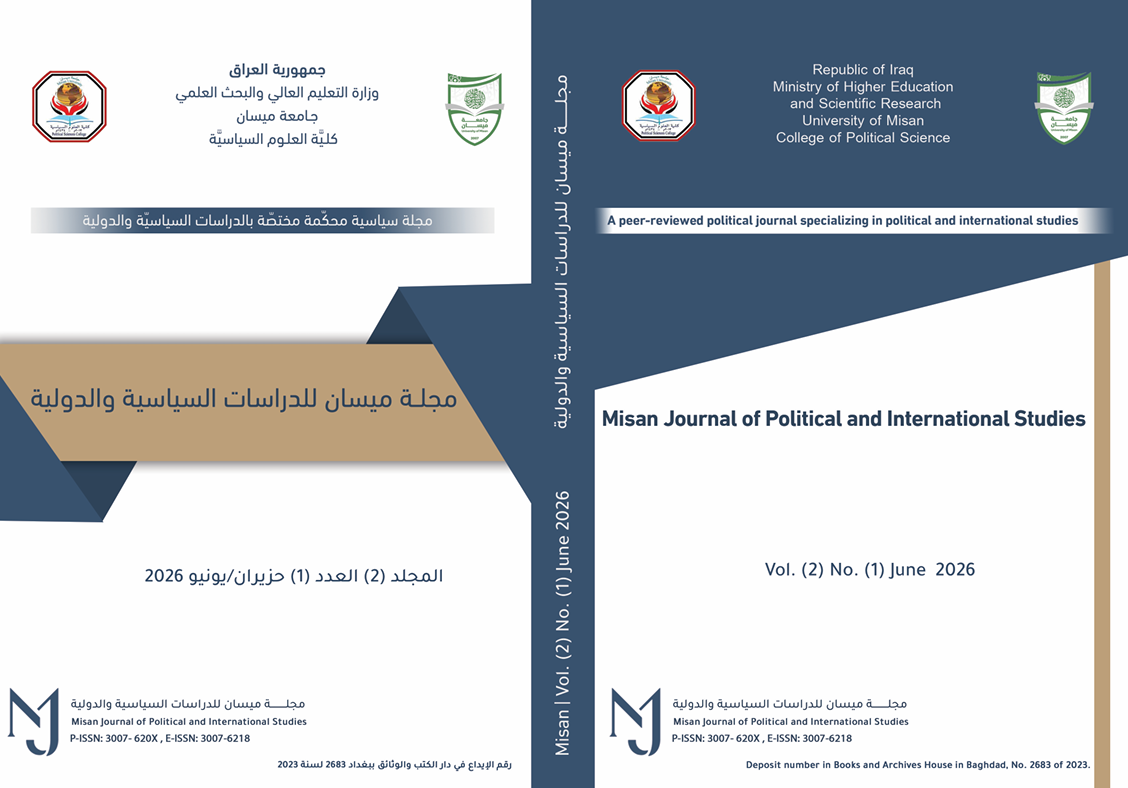
Vol. 2 No. 1 (2026): Vol.(2) No. (1) June 2026
					View Vol. 2 No. 1 (2026): Vol.(2) No. (1) June 2026

A peer-reviewed, biannual scientific journal specializing in the publication of research in political science, published by the College of Political Science at Misan University, founded in 2024.

Published: 2026-07-12

Full Issue

المقالات

  • The political role of the Kurds in Iraq post 2003

    Professor phd. Dina Hatif Maki
    8-35
    DOI: https://doi.org/10.65441/umisa.2026.02108
  • Peace Technology: Towards Leveraging AI Solution to Build Proactive International Peace

    Professor Dr. Azhar Abdullah hasan, Assistant Lectuer .Fatimah MohammedAli Talib
    36-49
    DOI: https://doi.org/10.65441/umisa.2026.02136
  • Climate Change and Its Strategic Implications for Iraqi National Security

    Assistant Professor Dr.Abbas Fadil Alwan
    50-68
    DOI: https://doi.org/10.65441/umisa.2026.02150
  • The phenomenon of private security companies and their growing role in implementing the strategies of major powers in the contemporary international system.

    Assistant Professor Dr. Hasan Rashak Ghayadh
    69-85
    DOI: https://doi.org/10.65441/umisa.2026.02169
  • India's Developmental Experience: Opportunities And Obstacles

    Assist. Prof. Dr. Nadia Fadhil Abbas Fadle
    86-107
    DOI: https://doi.org/10.65441/umisa.2026.02186
  • US-Qatari Relations One Year On (2012) Between Opportunities for Strategic Cooperation and the Challenges of the Regional and International Environment

    D.R. Israa Jawad Hatim
    108-140
    DOI: https://doi.org/10.65441/umisa.2026.021108
  • Challenges of Global Politics and Their Implications for Iraq: A Study of Regional and International Variables (2003–2025)

    Dr. Elaf Nawfal Ahmed , Asst Professor. Shaima Adel Fadel
    141-154
    DOI: https://doi.org/10.65441/umisa.2026.021141
  • Russian–Chinese Cooperation and the Reshaping of the International Order: A Vision of Global Multipolar Aspirations

    D.R. Karrar Theyab Abed
    155-172
    DOI: https://doi.org/10.65441/umisa.2026.021155
  •  Russia and North Africa: A Perspective on Geostrategic Expansion

    D.R Mohammed Jassim Hussein Obaid
    173-186
    DOI: https://doi.org/10.65441/umisa.2026.021173
  • Influential variables facing Saudi advancement in the Middle East

    DR. Khalaf Latif Ali Nayef
    187-197
    DOI: https://doi.org/10.65441/umisa.2026.021187
  • Employing digital diplomacy in foreign policy: The United State of American as a model

    Dr. Yawar Omar Muhammed
    198-211
    DOI: https://doi.org/10.65441/umisa.2026.021198
  • The Course of U.S.- Iranian Negotiations in 2025 and Their Implications for the Regional Environment

    D.R. Ghadir Abdulrasul Shway
    212-222
    DOI: https://doi.org/10.65441/umisa.2026.021212
  • Obstacles to peaceful coexistence in Iraq

    DR. Jaafar Alsadiq Mahdi atiya
    223-238
    DOI: https://doi.org/10.65441/umisa.2026.021223
  • The Role of Gulf cooperation council states in the Yemeni political conflict

    Dr. khalid abdulrajhman jabr
    239-257
    DOI: https://doi.org/10.65441/umisa.2026.021239
  • The Employment of strategic ambiguity in .U.S policy toward the Iranian nuclear program since 2015

    Dr. Zaid Ahmed Bader
    285-270
    DOI: https://doi.org/10.65441/umisa.2026.021258
  • Nato's role in the horn of africa after 2005

    Asst. Lect. Abbas qais abbas hayaba
    271-285
    DOI: https://doi.org/10.65441/umisa.2026.021271
  • Military Technology and the Reshaping of International Balances: Between Cyber Reality and the Persistence of Traditional Hegemony

    Asst. Lect. Ahmed Ali Dhiab Ahmed , Prof. Dr. Zeyad Tariq Abdulrazzaq Mohammed
    286-303
    DOI: https://doi.org/10.65441/umisa.2026.021286
  • The 2023 Presidential Election in Nigeria: Mechanisms and Objectives

    Assistant Lecturer: Raad Khudair Salibi
    304-320
    DOI: https://doi.org/10.65441/umisa.2026.021304
  • The Repercussions of the Ukrainian War on Russian-Turkish Relations

    Asst.lect. Zainab Dhiaa Mohammed Amin
    321-335
    DOI: https://doi.org/10.65441/umisa.2026.021321
  • The Conflict in Ethiopia’s Tigray Region (2020–2022): Roots, Causes, and Paths to Political Settlement

    Asst. Lecturer :Marwa Salman Hassan
    336-354
    DOI: https://doi.org/10.65441/umisa.2026.021336
  • The Principle of "Peaceful Rise" in Chinese Foreign Policy

    Assistant Lecturer: Zahraa Amir Hassan
    355-364
    DOI: https://doi.org/10.65441/umisa.2026.021355
  • The Popular Uprising in Libya in 2011 and Its Impact on the Political Process

    Asst. Lect. Tiba Dheyaa Muneam Issa
    365-373
    DOI: https://doi.org/10.65441/umisa.2026.021365
  • Foreign policy in the age of artificial intelligence: an analytical study of tools and influences-china as a model

    Assistant lectuer :mariam imad shakir , Assistant lectuer :fawzia raad ali
    374-392
    DOI: https://doi.org/10.65441/umisa.2026.021374
  • The Role of Government Subsidies in Supporting Small Businesses in Iraq

    Assistant Lecturer :Kolfikhar Falih Jehad
    393-409
    DOI: https://doi.org/10.65441/umisa.2026.021393
  • Nixon's visit to China and its impact on the two Koreas' declaration of the July 4, 1972 statement

    Researcher : Fatima Talib Kazim Obaid, Professor Dr. Muntaha Sabri Maula
    410-426
    DOI: https://doi.org/10.65441/umisa.2026.021410
  • Title: the impact of transformations in the new international order on fragile states

    Authors researcher: khattab dared abdullah, Professor dr: falah hassan hammadi, Assistant professor dr. Ali sabah saber
    427-442
    DOI: https://doi.org/10.65441/umisa.2026.021427
  • Areas of cooperation between Turkey and BRICS countries for the period 2006-2026

    Researcher: Jawaher Ibrahim Wahib , Prof. Muhammad Munther Jalal
    443-457
    DOI: https://doi.org/10.65441/umisa.2026.021443
  • Article Review(Impact of Economic Sanctions on Diplomatic Relations: A Comparative Analysis in United State)

    Dr.Maha Shukr Mahmoud Hassan
    458-459
    DOI: https://doi.org/10.65441/umisa.2026.021458
  • book Review (An Introduction to Political Science)

    Dr. Alya Abdulameer Abdulmajeed
    460-462
    DOI: https://doi.org/10.65441/umisa.2026.021460
  • Review of the article (Today, 96% of the world’s nuclear weapons are held by countries with authoritarian leaders)

    Assistant Lectuer : Samar Mahdi Jabbar
    463-465
    DOI: https://doi.org/10.65441/umisa.2026.021463
View All Issues